The candidates for the Conservative nomination at the last debate (PA MEDIA)
Six years ago, former Prime Minister David Cameron brought the idea of “Brexit” to the European Union in his attempt to impose UK supremacy on the EU after the signing of the Lisbon Treaty. UK was looking for more freedom in matters of immigration, welfare payments, financial safeguards, and the easiest ways to block EU regulations.
However, Mr. Cameron’s expectations about breaking with the EU went out of control. He created this ideal picture of a prosperous and powerful United Kingdom, ruling with its policies, laws, governments, and courts. And this set the mind of many British, who were struggling with income and State help.
Within those days in 2016, among many politicians who supported Brexit, Boris Johnson was the co-leader of the campaign to take the United Kingdom out of the EU.
After losing the referendum, Mr. Cameron stepped aside in 2016, and Theresa May took the lead not only for the Conservatives but for the whole British nation, which was about to face a veritable break up at national and international levels.
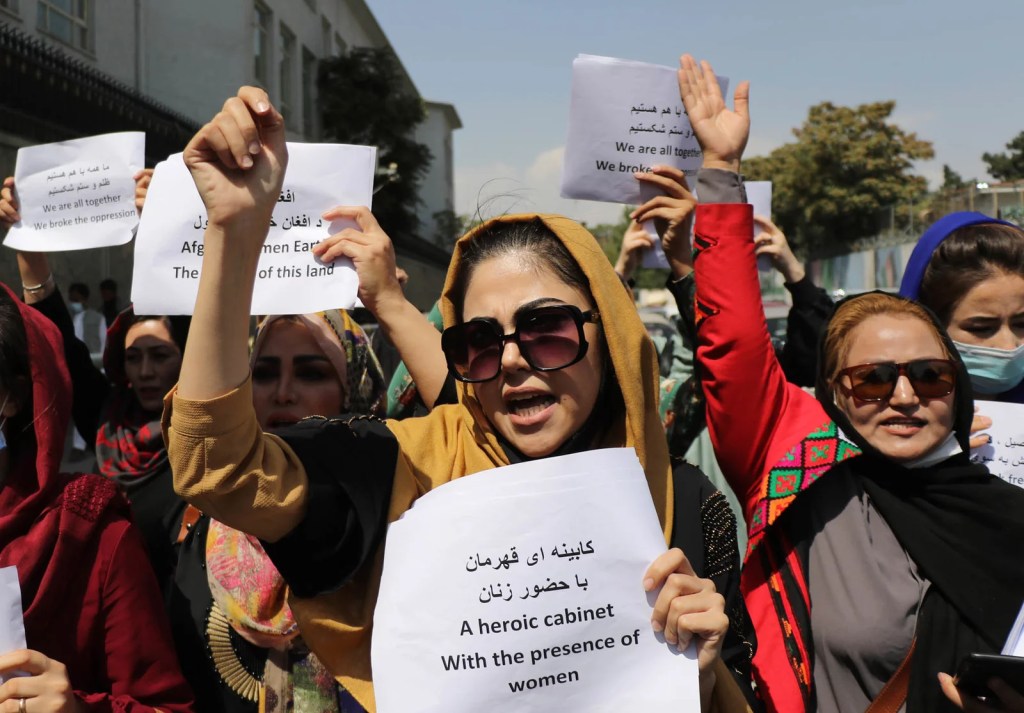
Women gather to demand their rights under Taliban rule during a protest in Kabul, Afghanistan, on Sept. 3. Wali Sabawoon/AP
“What the U.S. did to Afghanistan will never be forgotten or forgiven,” Yasna, an Afghan activist woman living in Canada, claims exclusively to Laager470.
In April of 2021, President Joe Biden announced that U.S. military forces would leave Afghanistan by September 1st. Since that announcement, the Taliban took advantage of it. They continued their offensive towards the capital, first threatening government-controlled urban areas, then seizing several border crossings, ending in direct assaults. On August 6, the Taliban captured the first provincial capital. Eleven days after, Kabul fell in its power. Afghan President Ashraf Ghani left the country while the Taliban entered the presidential palace.
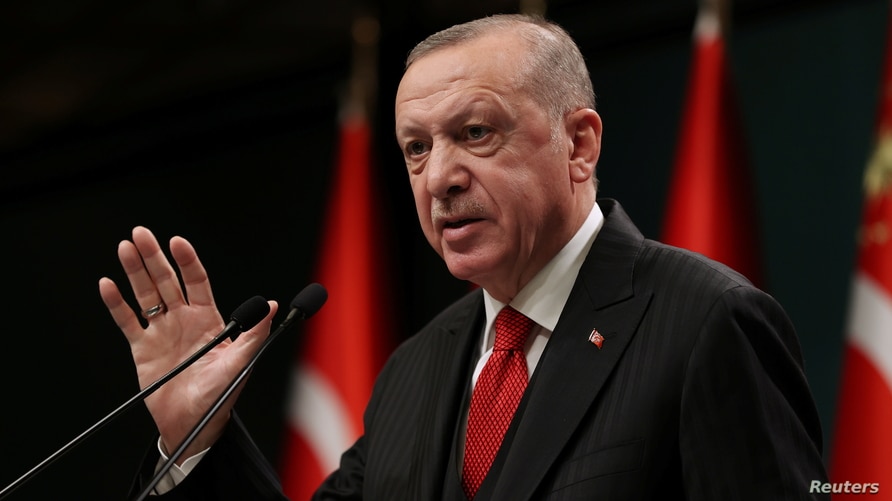
At the beginning of the Arab Spring, the governmental structure and policies of Turkey was the ultimate model that countries like Egypt, Iraq, or Syria were trying to imitate. Turkey used to represent the successful application of democracy, independent government, and the economic strategy administrated by Kemal Dervis in the early 2000s. It was the successful model of secular society in a large Muslim population. Also, its foreign policy of not having problems with neighbors catapulted it to be a European membership candidate. However, since the moment Recep Tayyip Erdogan stepped into his position in their government, this model evaporated along with all the progress made, facing a new era of social, economic, political, and foreign policy setbacks.
The country has been facing a deep economic depression since 2016.The first cause was the Turkish government’s gradual involvement in the Syria war back in 2011, which ended up with military interventions five years later. Erdogan’s goal, taking a heavy toll on the economy, was to become a crucial actor in the Syrian war map to eventually be considered part of the future peace plan.
Since then, the Turkish economy has progressively deteriorated, and consumer and investor confidence has been severely rattled. Nowadays, the country faces a rise of inflation of 4%, placing the lira at its highest rate against the dollar last November, more than 10%. After this data was made public, Erdogan presented a new economic route to save the lira. His reform will be based on “lower inflation and international investment.” An indication that his plan has nearly zero credibility for locals and investors is that citizens’ interests in gold and foreign exchange have increased and it will continue until real changes spring up. Another sign is that in Istanbul’s bazaar with gold coins and jewelry are selling at 3% above the international market.
Ebrar Turzna, using a fictional name to protect her identity, a local Turkish citizen, confess to this blog that the economy “is the worst it has ever been.” For her, things are only getting worse. “Richare getting richer; poorare getting poorer. Also, there’s big unemployment. Whatever you do, whatever is the level of education you achieve, it doesn’t matter. You either have someone you know in the company,or you do extreme things to be apart from the rest of the population to be just considered. It didn’t use to be like this”.
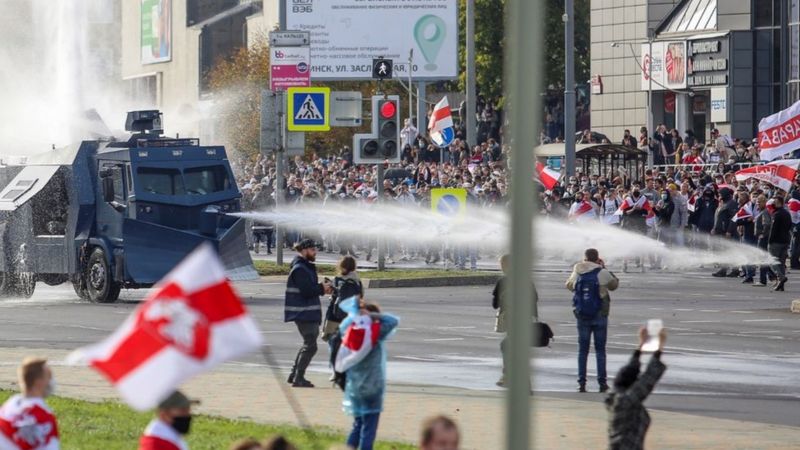
It has been almost two months since the elections on 9 August in which the current president of Belarus, Alexander Lukashenko, claimed a victory with 80% of the votes. The results were denounced right away and cataloged as a “fraud” by the opposition and the international governments. Consequently, Belarusian took the street to protest against the president, who has been in power since 1994, the first presidential elections of the country after its separation from the Soviet Union three years earlier.
With the rights of freedom and democracy at risk, the Belarusian took the streets for the eighth weekend in a row in the capital and others demanding the resignation of Lukashenko cities. This time, the police used water cannons to disperse mass in Minsk, where 100,000 people gathered as every Sunday, while the mobile internet was down.
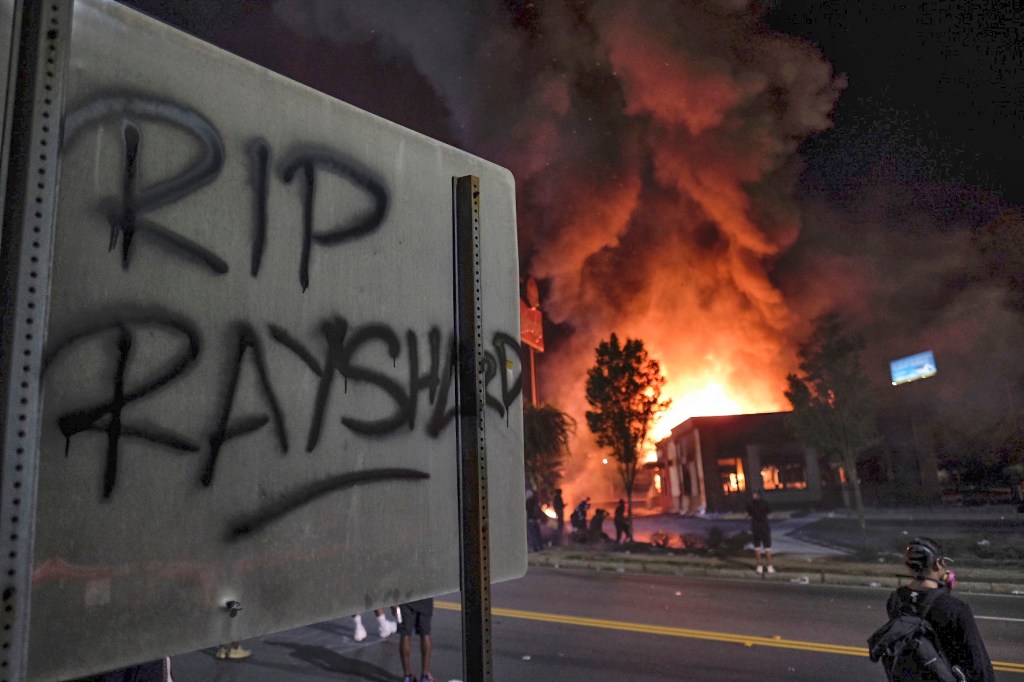
A Wendy’s restaurant, background, burns Saturday, June 13, 2020, in Atlanta after demonstrators set it on fire. D. (Ben GrayAtlanta Journal-Constitution viaAP)
The Black Lives Matter movement (BLM) reinvigorated by the death of George Floyd on May 15, in Minneapolis, MN. Since the first days of the social movement reawakening, the rioters led the protest with violence and vandalism. Their acts were in retaliation to Floyd’s death, breaking, smashing doors and windows, covering with graffiti hundreds of boarded-up businesses, and setting fire to nearly 150 buildings. According to the Minnesota local’s newspaper Star Tribune, the riots caused “millions in property damage to more than 1,500 locations”. The damage in city buildings it claims, and it affirms the cities restaurants and retail stores were hit the hardest during the rioting.
Over the last two months, the BLM morphed into the political atmosphere, developing debates over the validity of looting and rioting and finding support in the democrat wing, which justifies the violence as a natural consequence of years of “oppression.”
With the nationwide acceptance of the way the protests were taking place, it facilized BLM to gain ground among states and gave them a free path to scale to another level. Consequently, they’ve been feeling more powerful to put on the table new demands such as the tearing down of historical statues, interfering the course of history, the slavery reparations, or the idea of defunding the police.
Jess Baddams, paramedic, holds a blood sample as she poses for a photograph during an antibody testing program at the Hollymore Ambulance Hub, in Birmingham, England, on Friday, June 5, 2020. Making antibody tests widely available may help Britain lift its lockdown restrictions, because they show who has already had the COVID-19 and might have a degree of immunity from coronavirus. (Simon Dawson/Pool via AP)
Three months ago, humanity was worried about everything but not about a virus called Covid-19, or as it is known socially the Coronavirus. The events that marked the global agenda 90 days ago were overshadowed after its appearance.
In one hand, the Americanswere beholding the way the former vice-president, Joe Biden, the progressist senator, Bernie Sanders, and the senator for Massachusetts, Elizabeth Warren, from the same left-wing that his collague, were fighting to get the nomination and to face President Trump in the next elections late this year. In the other hand, the Europeans were dealing with the divorce between EU and Uk after more than three years of negotiations, and at the same time, they were looking for a new identity by the hand of the new president of the European Commission, Ursula Von der Leyen, to address and reduce the increasing nationalist movements that were threatening get Europe broken in many pieces. At the same time, Middle East was waiting for Netanyahu’s plan to annex the West Bank, waving the anger of all the Muslim countries that surround the Jewish State. And last, but not least, Xi Jinping pursued to bring down the Hong Kong autonomy, including the idea of “one country, two systems”, (which nowadays it was achieved due to the new law that permits to extradite people from the Special Administrative Region to Bejing to stand trial by any action that is against the Government), to take full control of China and to establish the communists, and moreover, to hide and minimize what it was going on in Wuhan.
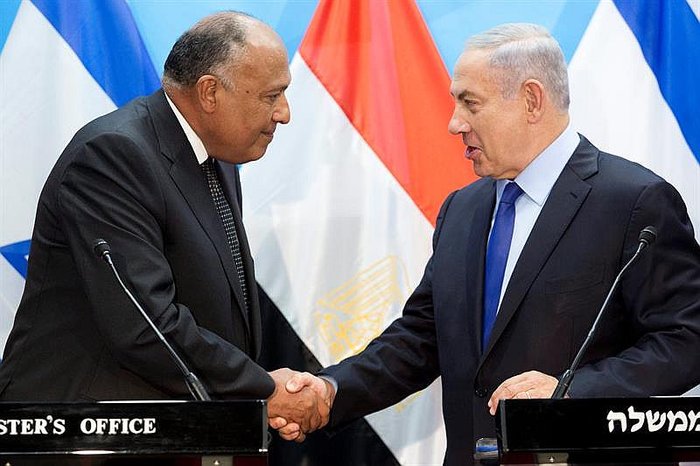
Every time, the rapprochement between Israel and Egypt is clearer and evident. Four decades have passed since Egypt decided to set up to negotiating a pace with Israel in 1979, as a consequence of the disastrous final to them in the Yom Kippur war in 1973.
It was there the beginning of the relation between these two powers. Nevertheless, with the Honsi Mubarak fail in 2011 and the raise to the power to the Islamic one of Mohamed Mursi (perceived as a clear threat for Israel) of the Muslim Brotherhood, produced a cooling of the relations between these two countries.
The cooperation among Israel and Egypt has improved notably since Al- Sisi took the control of the Egypt government in 2013.
Conocimiento es poder. Esta simple frase encierra una de las claves del universo, pero pocos logran reconocerla. Por ello, por intentar acercarme, al menos, un poco más a ese Nirvana de la sabiduría he empleado parte de la pasada semana en un curso de la universidad de verano de El Escorial organizado por la UCM, aprendiendo, sólo un poquito, de ese mundo oscuro, inquietante y lamentablemente, emergente, que es el terrorismo internacional.
Es curioso cómo, cuándo intentas cerrar respuestas, inevitablemente, se abren muchas más preguntas, simplemente por contacto con una realidad (la que sea) desconocida en inicio. En este caso la radicalización y estrategias para la prevención. Y fruto de ese esfuerzo por empujar tus límites, te pones en contacto con otras personas que te obligan/ayudan a pensar. Toda una experiencia que os animó a que si tenéis la oportunidad, aprovechéis.
Por tanto y antes de pasar el tema que nos concierne, quería dar las gracias a todos los que han hecho posible este curso: a Luis de la Corte(director de este programa y profesor titular de Psicología Social y Director de Estudios Estratégicos e Inteligencia del Instituto de Ciencias Forenses y de la Seguridad en la Universidad Autónoma de Madrid); a la Fundación de Víctima del Terrorismo ,en especial a María Mar Blanco (presidenta de esta fundación) y a la Fundación Centro Memorial de las Victimas del Terrorismo.


 Laager 470