Six years ago, former Prime Minister David Cameron brought the idea of “Brexit” to the European Union in his attempt to impose UK supremacy on the EU after the signing of the Lisbon Treaty. UK was looking for more freedom in matters of immigration, welfare payments, financial safeguards, and the easiest ways to block EU regulations.
However, Mr. Cameron’s expectations about breaking with the EU went out of control. He created this ideal picture of a prosperous and powerful United Kingdom, ruling with its policies, laws, governments, and courts. And this set the mind of many British, who were struggling with income and State help.
Within those days in 2016, among many politicians who supported Brexit, Boris Johnson was the co-leader of the campaign to take the United Kingdom out of the EU.
After losing the referendum, Mr. Cameron stepped aside in 2016, and Theresa May took the lead not only for the Conservatives but for the whole British nation, which was about to face a veritable break up at national and international levels.
Theresa May was known for her belief in a soft Brexit, a way to maintain close ties with the EU, thus, keeping some privileges for the UK. Her government entirely focuses on the Brexit negotiations. She paid extra attention to the question of the border of Northern Ireland, the circulation of goods and services, and the freedom of movement of British and European citizens. During this time, Boris Johnson served as Foreign Secretary. Johnson’s idea of leaving Europe with a radically different economic relationship between the UK and the EU. And this vision took him to resign in 2018 in opposition to Ms. May’s Brexit deal.
After that, Mr. Johnson returns to be a Parliament member. On June 7, 2019, Theresa May resigned as a Primer Minister over her third failure to pass the Brexit in Parliament. She couldn’t present a plan to safeguard the UK’s supremacy and control on the Northern Ireland border. Her departure left the country more divided than it was two years ago. It was divided not only in terms of the Brexit itself but for an economy that started to give clear signals of slowdown, as well as the issues of the public and health system that was being neglected.
Boris Johnson sought the opportunity and took control of the British political game in 2019 due to the last-minute support of Northern Ireland’s Democratic Unionist Party. Johnson’s campaign focused on achieving a deal by October 31, 2019, “with or without a deal.“
As a strategy to force the Parliament to thwart a no-deal Brexit, Johnson shut down the Parliament. This decision was cataloged as “unlawful” by the UK Supreme Court on September 24, 2019, turning down’s Johnson’s strategy. After this loss, Johnson dissolved the Parliament and set a date for general elections. On December 12, 2019, the Conservative Party won an 80-seat majority, making Johnson the most electorally successful Conservative leader since Margaret Thatcher. This victory gave him the backing to push through Brexit legislation.
“Brexit must happen,“- Ella, a British friend, told me after seeing the election results.
“Foolish people voted for it. Now, we cannot go back on it. Brexit has to happen; what happened today does not stop the fact that Brexit still needs to be sorted. Now, we are onto Boris,” she continued.
For her, Brexit was “inevitable” and “it must to happen either way,” and “it might as well get it done now than pay EU millions until it is done.“
On December 30, 2019, Ella’s prediction became true, and the Brexit bill passed the UK parliament by 521 votes to 73.
Keir Starmer, the Labour party’s leader, recognized before that vote that Boris’s Brexit was the “the choice.“
At that instant, Boris Johnson had everything he had always dreamed of, and it became clear he kept his campaign promises. However, Brexit wasn’t over yet, and the agreement left some issues to deal with: Northern Ireland, fishing, and Gibraltar.
Against all odds, Covid hit, and Johnson’s throne started to fall apart. As the government put all his efforts in surviving the virus, imposing restrictions to the population, the UK began to suffer the consequences of the pandemic. Lack of supplies, good and services, and a weak health system. And as the lockdowns were getting extended, the economy was shrinking by leaps and bounds.
Additionally, Johnson and his cabinet tempted fate as different scandals started to come to light: the party-gate, the Owen Paterson case, or the Chris Pincher sexual controversy.
As a result of this lack of ethics and abuse of power from the Government, Johnson’s prestige started to break apart at the same time that top figures from his own cabinet began to resign. And it concluded with Johnson’s resignation.
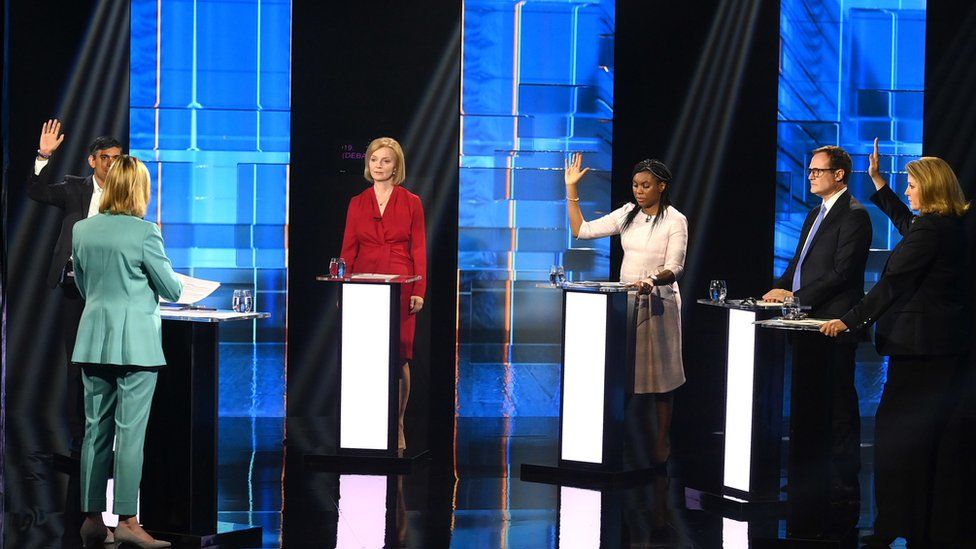
As the Conservative Party is looking for a new leader, there are a lot of expectations on finding a future Prime Minister who will save them from the economic storm approaching. Nevertheless, the real questions shouldn’t be about who but how to put Britain back on track. How to fix an economy that has inflation of 9.1%; an exacerbated cost-of-living crisis that threats to impoverish more people by winter; the risk of a trade war with the EU; and a Brexit deal that is still looking for answers in terms of sovereignty and control over its borders (Northern Ireland -Scotland- Gibraltar). But also a political system that lacks protocols, guidance, and wisdom to recognize where is the line between acceptable and unacceptable, the line between loyalty and treason. It is a thin and delicate line that every political party has. And once you cross it, it completely changes the course of the boat, leaving people behind and establishing new leaders on the summit.
Therefore, the dilemma here isn’t about who will be the new face of the government and the Conservative Party. The critical point is that if there’s anybody who can share a unique perspective, an individual who may be able to dive out into these turbulent waters, where finding common ground among the different parties would be crucial for the future of the United Kingdom.

