“What the U.S. did to Afghanistan will never be forgotten or forgiven,” Yasna, an Afghan activist woman living in Canada, claims exclusively to Laager470.
In April of 2021, President Joe Biden announced that U.S. military forces would leave Afghanistan by September 1st. Since that announcement, the Taliban took advantage of it. They continued their offensive towards the capital, first threatening government-controlled urban areas, then seizing several border crossings, ending in direct assaults. On August 6, the Taliban captured the first provincial capital. Eleven days after, Kabul fell in its power. Afghan President Ashraf Ghani left the country while the Taliban entered the presidential palace.
“We succeeded in what we set out to do in Afghanistan over a decade ago,” President Biden declared on August 3, a day before the withdrawal completion.
However, Yasna sees reality differently. “There was no proper preparation and no proper strategy in terms of their withdrawal. We can see it with all the weapons and military equipment they’ve left behind, which, unfortunately, fell into the wrong hands,” Yasna says.
Asked about how the outcome had occurred when Afghans were warning for over four years that the U.S. would be gone, Yasna explains that in the Doha agreement of 2020, “Afghanistan was never part of it.”
“This agreement was done behind closed doors. Afghanistan never wanted the Taliban. Yet these terrorists were given a seat to have a say in Afghanistan’s affairs and future. Afghanistan was pretty much sold. And when the Taliban came, the government, which sold out Afghanistan, told our military to drop their weapons and that the Taliban come in peace. Our weapons, our military equipment was handed off to the wrong hands,” Yasna marked out.
Sina Naderi, the creator of “Said Jawed Foundation” in Sweden and Afghan activist, believes that the return of the Taliban took place because of the “corruption of the Afghan government.” “Our government was deeply corrupt, and since the U.S. left, they gave all the power to the Taliban. And now they have access to all the advanced weapons, which make it very difficult to defeat them,” Sinaaj said.
Ms. Naderi told Laager.470 she possesses “many videos and voice messages from Afghan generals and soldiers crying” while trying to “go and fight.” However, in those pieces of evidence, you hear President Ashraf Ghani “saying no” to this defense action.
“I have some relatives that used to work in the Afghan Parliament. They tried to fly away from the country when the situation got worst (before the withdrawal), but the President never allowed them to do it”. For her, the former President “sold out his country and his people,” Ms. Naderi tells.
The adverse events that followed the U.S. withdrawal from the Middle East Country raised rejections within Americans against the U.S. government. According to the survey conducted by Pew Research Center on August 23-29, 42% of Americans say that leaving Afghanistan was a wrong decision, 69% believe that the United States didn’t achieve its goal, and 42% rated Biden’s handling situation as poor.
Since taking control of Kabul on August 15, and with the U.S. gone from the geopolitical board of Afghanistan, the Taliban had been taking away the rights and freedom the country had achieved in the last years.
“At the beginning, when the Taliban took power, they were acting low-key because the spotlight was on them. But slowly, and with the attention on other matter, they have been taking away so many rights from our people, especially from women,” Ms. Naderi said.
The Taliban have imposed severe restrictions on women and girls based on Sharia (Islamic law). Women have been excluded from returning to work or traveling in public without being accompanied by a male guardian. Girls above 12 cannot go to school, and the rigid gender segregation at university has severely curtailed women in higher education.
“This agreement was done behind closed doors. Afghanistan never wanted the Taliban. Yet these terrorists were given a seat to have a say in Afghanistan’s affairs and future. Afghanistan was pretty much sold.”
“Right now, Afghanistan and the progression of our women don’t go hand in hand with the new regime. We feel betrayed by all the women activists as well. Why isn’t anyone hearing them? It’s terrifying. My aunt in Afghanistan is the principal of a school, and my uncle’s wife is a teacher – there it goes their professions“, Yasna expresses.
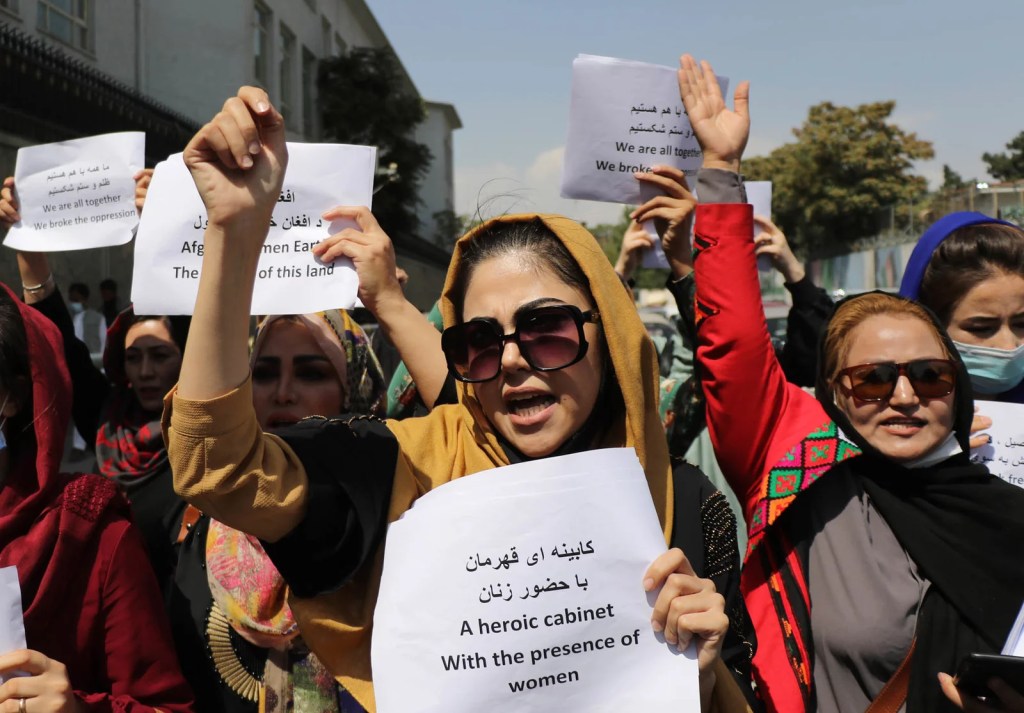
As a reaction, women took the streets to protest against these rules. Social media emerged as the principal channel to broadcast these demonstrations, where it exposed the use of violence to dispel the protesters. Millions of users expressed their concerns and called for action by the international community.
Consequently, the U.S. and its allies have signaled that financial assistance and symbolic acceptance of the Taliban and holding off the flash appeal in the country to assure the Taliban will respect human rights. However, this uncertainty and the lack of assistance have led the country to a more profound economic and humanitarian crisis.
Jacob Kurtzer, director and Senior Fellow on Humanitarian Agenda at Center for Strategic and International Studies, explained on his analysys that “over 18.4 million people need humanitarian assistance and more than 30 percent of the population (12.2 million people) are facing an emergency or crisis levels of food insecurity, with half of all children under five facing acute malnutrition.”
Mr. Kurtzer also adds that “attacks against humanitarian workers and infrastructure continue to pose a significant threat to the delivery of critical service” (over 2021, at least 32 aid workers were killed, 86 injured, and 55 abducted).
“According to the United Nations Development Programme’s most recent assessment, Afghanistan is heading toward universal poverty. As much as 97% of the population is at risk of falling below the poverty line by mid-2022-compared to the current poverty rate of 72%—unless the country’s political and economic crises are curtailed,” Mr. Kurtzer marked out.
Additionally, Mr. Kurtzer exhibits the “extremely operational challenges” for humanitarian actors since “the Taliban are a Specially Designated Terrorist Group (SDGT)” and, at the same time, “the de facto government of Afghanistan”.
“Right now, Afghanistan and the progression of our women don’t go hand in hand with the new regime. We feel betrayed by all the women activists as well. Why isn’t anyone hearing them? It’s terrifying.“
Trying to get acceptance by the international community and, therefore, the entry of humanitarian help, the Taliban has been focusing its effort on developing press conferences during the last four months. During those conferences, Taliban representatives have been assuring that “women’s rights will be respected,” “girls will be allowed to return to school,” “the banning of forced marriage,” “or “declaring women free.“
Notwithstanding, Yasna warns about “the narrative that the Taliban have created” to “get legitimatized.”
“How are they to know their equal rights if education is banned to women? Taliban said they would give women rights to an extent, but I haven’t heard the part where they want to educate them,” Yasna reflects.
“The media is really good at changing narratives of the bad guys. No one asked an Afghan in Afghanistan about the situation, and everyone ran to U.S. officials and brought Taliban spokesmen to speak for us,” Sina adds.
It’s been four months since the withdrawal, and the situation escalates every day. With a hunger, humanitarian, health, and economic crisis, with 14,000 legal permanent U.S. residence trapped yet in Afghanistan, 3.5 million people internally displaced by conflict, and 3.2 million children at risk of acute malnourishment, as well as the constant violations of human rights, the future of the country is hanging on the balance.
“People in Afghanistan didn’t want the Taliban because they already experienced in 1996 what it supposes to be ruled by them,” Ms. Naderi marks out.
Cheek to cheek, Yasna states that “Afghanistan progressed quite a bit since the last fall of the Taliban.” “In the past 20 years, Afghanistan opened so many doors for women, girls’ education, women in politics, women in the work field. Our infrastructure became more stable. I personally had the hopes of perhaps moving back home at one point in time,” Yasna says as she contemplates how her dream fades as quickly as the snow on a sunny day.
 Laager 470
Pingback: «What the U.S. did to Afghanistan will never be forgotten or forgiven» — Laager 470 – Conavegación | Blogosfera