It has been almost two months since the elections on 9 August in which the current president of Belarus, Alexander Lukashenko, claimed a victory with 80% of the votes. The results were denounced right away and cataloged as a “fraud” by the opposition and the international governments. Consequently, Belarusian took the street to protest against the president, who has been in power since 1994, the first presidential elections of the country after its separation from the Soviet Union three years earlier.
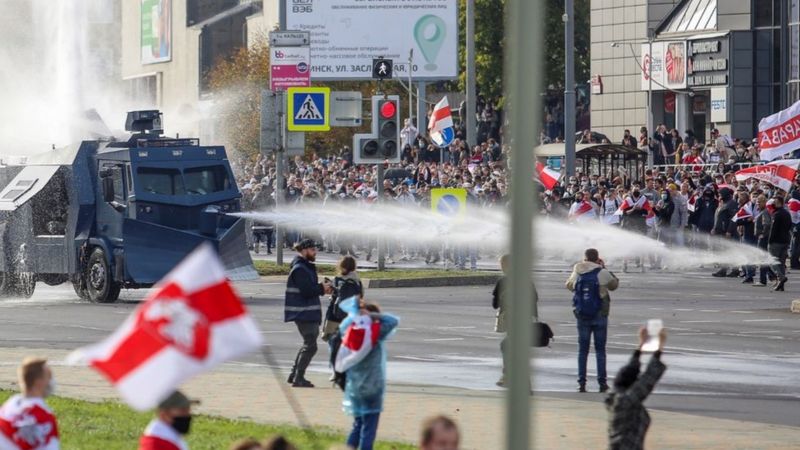
With the rights of freedom and democracy at risk, the Belarusian took the streets for the eighth weekend in a row in the capital and others demanding the resignation of Lukashenko cities. This time, the police used water cannons to disperse mass in Minsk, where 100,000 people gathered as every Sunday, while the mobile internet was down.
Nowadays, the country is submerged in an atmosphere of backlash. The peaceful protestants are being detained by the police and army, tightly controlled by the president. Also, the members of the opposition council, the non-governmental body created to facilitate the democratic transfer of power, are being vanished, detaining, and even forced to leave the country or to face a trial in where they are accused of seizing power from President Lukashenko. Because of that, only one of the seven-person leadership of this group is still free. It is the Nobel-prize winning writer, Svetlana Alexievich. She declared one week ago in front of a group of journalists and EU diplomats that his brutal tactics “would not work and the protest movement would continue.” “We want the dialogue to start,” she claimed.
With our eyes on the trials that the opposition council members face, everything points out that the protests will continue. Besides all the threats and the government’s intent to scare the population, Byelorussians are willing to take the streets all the weeks necessary until Lukashenko is out from the presidency to start the transition of power and to take a path to democracy.
As the country faced another week of turbulence, the EU faced another week of its failure to agree among the 27 members to impose Belarus sanctions, which would stop Lukashenko’s plan to perpetuate in power indefinitely. Regardless they efforts to get that approval, the European Union shows its lack of response in what matters to foreign policy.
Since Donald Trump and his isolationism arrived at the White House, the EU leaders tried to update its structure to become geostrategy and independent autonomy that could lead the global stability. And with the election Ursula von der Leyen as the new European Commission Leader, they were picking a different candidate who could create a unique leadership style. But, since the unanimity of all the members is necessary to make foreign policy decisions, the EU credibility has dented in front of international society. And even they already got the approval of the 27, and they don’t recognize Lukashenko as president, it is clear they are still far from being that international actor that could bring help and defense of democracy when it is needed.
After showing that unity during the Brexit process, it disappears when it comes to things that can damage its integrity and sovereignty as an individual state, instead of looking for the interest of all the group. In this particular case, Cyprus was defying the EU sanctions to the 40 members accused of rigging the August presidential election, as it urged to also apply sanctions on Turkey over its oil and gas drilling in the Mediterranean. This shows the lack of integrity of Europe, who will need more changes, persistence, and collaboration of every single State.
In the meantime, different regional actors as Russia will take advantage of this deficiency to improve their presence in places where there’s a power vacuum. As a real example, we have the annexation of Crimea’s region in 2014. Russia, who highlights its capacity to involve in all kinds of situations in the name of the Russian defense, glimpsed an opportunity to impose its sovereignty in the southeast of Ukraine while the country was facing protests against the former president Viktor Yanukovych. Due to that lack of law and order, the crisis started from the rejection of Yanukovych to the EU economic integration deal and then heightened ethnic divisions. The result was the Donetsk and Luhansk region’s declaration of independence from Ukraine. And any international actors, including the US, could have reverted this situation and return the sovereignty to Ukraine’s government.
The same thing is happening right now in Belarus, with Russia offering and sending help militarily and economically to help Lukashenko move on with this crisis. With this taction, Putin is looking to create the dependency of Belarus in political integration and economic, foreign, and defense policy to, ultimately, add Belarus to the full-fledged Union States and the full absorption of Belarus.
To avoid this future, we should act fast and restore the order and the democracy in Belarus before it is too late. And it must be based on economic sanctions for the country with special focus on the country’s leaders who force a government change.
 Laager 470